Community feedback sought on Lower Great Southern desalination
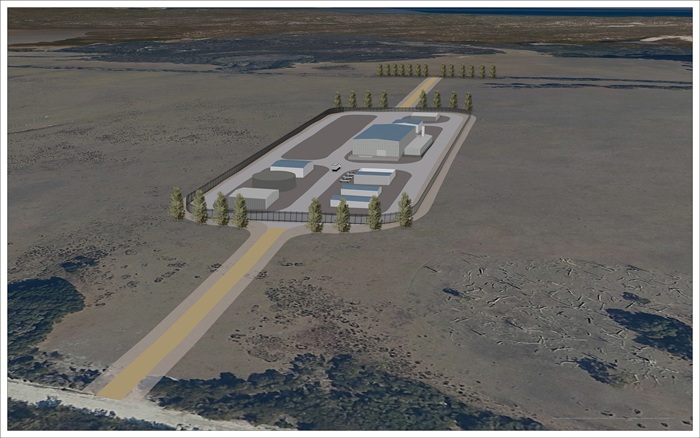
Early artist's impression of the proposed desalination plant, subject to further design and engineering
- Local feedback to help guide planning and detailed design phase for proposed small-scale desalination plant
- Water Corporation committed to minimising social and environmental impacts
- New water source required by 2030 to meet demand and support growth
Albany residents who live near or regularly use the Nanarup area are being encouraged to apply for Water Corporation’s community consultation group, as it seeks local feedback on the proposed small-scale desalination plant.
Nanarup was confirmed last month as the preferred area for a future plant, required to meet demand beyond 2030 and support economic and population growth across the Lower Great Southern.
Launched last year, the independently-facilitated group will help ensure community values, interests and concerns are understood and considered alongside technical, environmental and regulatory requirements.
Nanarup was selected on a range of technical, environmental, operational, and economic criteria with the project now progressing to the detailed planning and design stage. Further investigations will be undertaken, including geotechnical, environmental, Aboriginal heritage, and marine studies.
Water Corporation Great Southern Regional Manager Adrian Stewart explained the importance of addressing the social and environmental aspects of the proposed plant.
“We have the experience and expertise to design and operate a desalination plant without adversely impacting the Nanarup community, including recreational users of the beach. We are very mindful of the social and natural values of the area and insights from the community consultation group will be an important consideration during the design process,” Mr Stewart said.
“This will be a relatively small, discreet facility, set back from the beach. Shielded by dunes, we expect the plant to be hidden from the Nanarup beach with no permanent change to beach access.
“We’re looking for new members to join the consultation group, particularly Nanarup residents or anyone who regularly uses the area, to help support the design process.”
The proposed plant is expected to deliver an initial capacity of three billion litres of drinking water a year, supplying Albany, Mount Barker, Kendenup, and Narrikup, and supporting Denmark as required.
To support ongoing planning, geotechnical investigations will commence on 22 March within a small section of Nanarup Beach, west of Taylor Inlet. This will involve low-impact drilling to analyse soil, rock, and groundwater properties to determine ground strength and stability.
Due to the long-term impacts of climate change and accelerated growth, seawater desalination is increasingly supporting the state’s water future. In regional WA, Exmouth, Onslow and Karratha currently have plants in planning or delivery and, in the Perth metro area, the first stage of the Alkimos plant will enter service in 2028.
For more information on the community consultation group, including how to apply, visit watercorporation.com.au/LGSnewsource
ends/more
NOTES TO EDITORS
Lower Great Southern seawater desalination fact file
- Desalination is a proven and low-impact water source, not reliant on rainfall, that provides a sustainable and reliable supply of drinking water.
- A future plant in the Lower Great Southern will be relatively small and visually more discreet with an initial 3GL (billion litre) capacity, subject to further design and modelling, vs 100GL at WA’s largest desalination plant.
- Seawater desalination uses very fine membranes, acting like microscopic strainers, to separate water molecules from seawater in a process called reverse osmosis. About 40-45% of the seawater becomes freshwater for drinking and the remaining 55-60% is brine (concentrated seawater).
- A bespoke diffuser is used to gently disperse the brine back into the ocean at depth.
- For a smaller facility in Albany, the brine will be fully diluted within tens of metres of the discharge point, making it indistinguishable from surrounding seawater.
- Water Corporation has successfully operated desalination plants for almost 20 years, demonstrating it can be delivered with negligible environmental impact.
ends/all