Why Albany needs more than rainwater tanks
Imagine if every home in Albany had a rainwater tank.
Every drop of rainfall captured from every rooftop, stored away for a day when it’s needed most.
It’s an appealing idea, and one that highlights the important role rainwater harvesting can play in reducing demand on our water supplies. Used alongside other water-saving measures and reliable water sources, rainwater tanks can help support a more water-secure future.
But securing Albany’s long-term water future requires more than capturing rain when it falls. It requires a reliable supply that can support homes, businesses, schools, hospitals and essential services every day. Including during the extended dry periods when rainfall is low and demand is highest.
So, why can’t widespread use of rainwater tanks provide all Great Southern’s future water needs?
The answer comes down to reliability.
Why aren't rainwater tanks enough?
Rainwater tanks can help households save water, but their supply depends entirely on rainfall.
A useful way to think about a rainwater tank is as a household pantry. It can store supplies when they are available, but it depends on regular deliveries to stay stocked. If deliveries stop for a long time, eventually the pantry runs out.
Rainwater tanks work in a similar way. They can only collect water when it rains and can only store a limited amount before overflowing. During dry periods, tanks gradually empty and may not refill for weeks or months.
While this may be manageable for an individual household, supplying water to an entire community is a much bigger challenge.
A public water supply must provide enough water for homes, schools, hospitals, businesses, emergency services and future population growth. It must also be available every day, not just when rainfall is plentiful.
That's why reducing demand and supplying water are not the same thing. Rainwater tanks can help reduce demand on the public water supply, meaning less water is needed from the scheme. But reducing demand does not create a new source of water.
To achieve long-term water security, both are needed: using water efficiently and securing reliable water supplies that can support the community through dry periods and future growth.
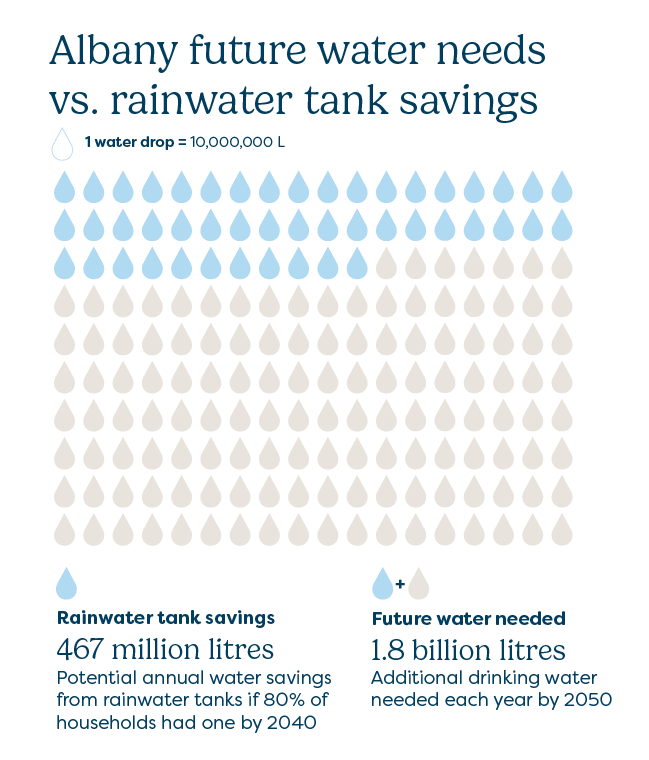
This infographic is based on 2023-24 rainfall data from Little Grove, Albany. Rainwater collection estimates are calculated using the formula: Rainfall (mm) × Catchment Area (m²) × Runoff Coefficient (0.8). The example assumes annual rainfall of 681 mm, a 150 m² roof area, and a roof runoff coefficient of 0.8, resulting in a potential rainwater capture of approximately 81,720 litres per year per dwelling. Future water savings estimates are based on projected dwelling numbers in Albany by 2040 and should be considered indicative only.
Climate change is reducing reliability
Water planning must consider the climate of the future, not the climate of the past.
Climate projections indicate Albany's average annual rainfall could decline over coming decades. Less rainfall means less water available to fill rainwater tanks, replenish groundwater aquifers and support dams and river systems.
At the same time, higher temperatures are expected to increase evaporation and water demand, placing additional pressure on existing water sources.
Because rainwater tanks rely on rainfall, they become less reliable when rainfall becomes less reliable.
That's why water systems must be designed to provide enough water in the driest years, not just the average years.
The role of rainwater tanks
Rainwater tanks can help some households reduce their use of scheme water and form part of a broader approach to water efficiency. However, rainwater tanks alone cannot provide the reliable, large-scale water supply needed to meet Albany’s future water needs.
Meeting the region’s long-term water needs requires both water-saving measures and reliable water sources that can continue supplying water during droughts and extended dry periods.
Rainwater tanks are part of the solution, but they are not the solution on their own.
See what we're doing to help secure the Great Southern's water future
Meeting the region’s future water needs will require both water-saving measures and reliable sources of water. Explore how we’re planning for the future through the Great Southern water source and desalination project.