Port Hedland water source planning
Project goal:
We are planning for the long-term water supply in the Port Hedland area to meet growing community and industrial needs, and the region's evolving climate.
Status:
In planning
Timeframe:
Ongoing
What’s happening?
We are investigating all viable future water supply options for the Port Hedland Town Water Supply Scheme. These include groundwater sources and seawater desalination.
Where does Port Hedland currently get its water?
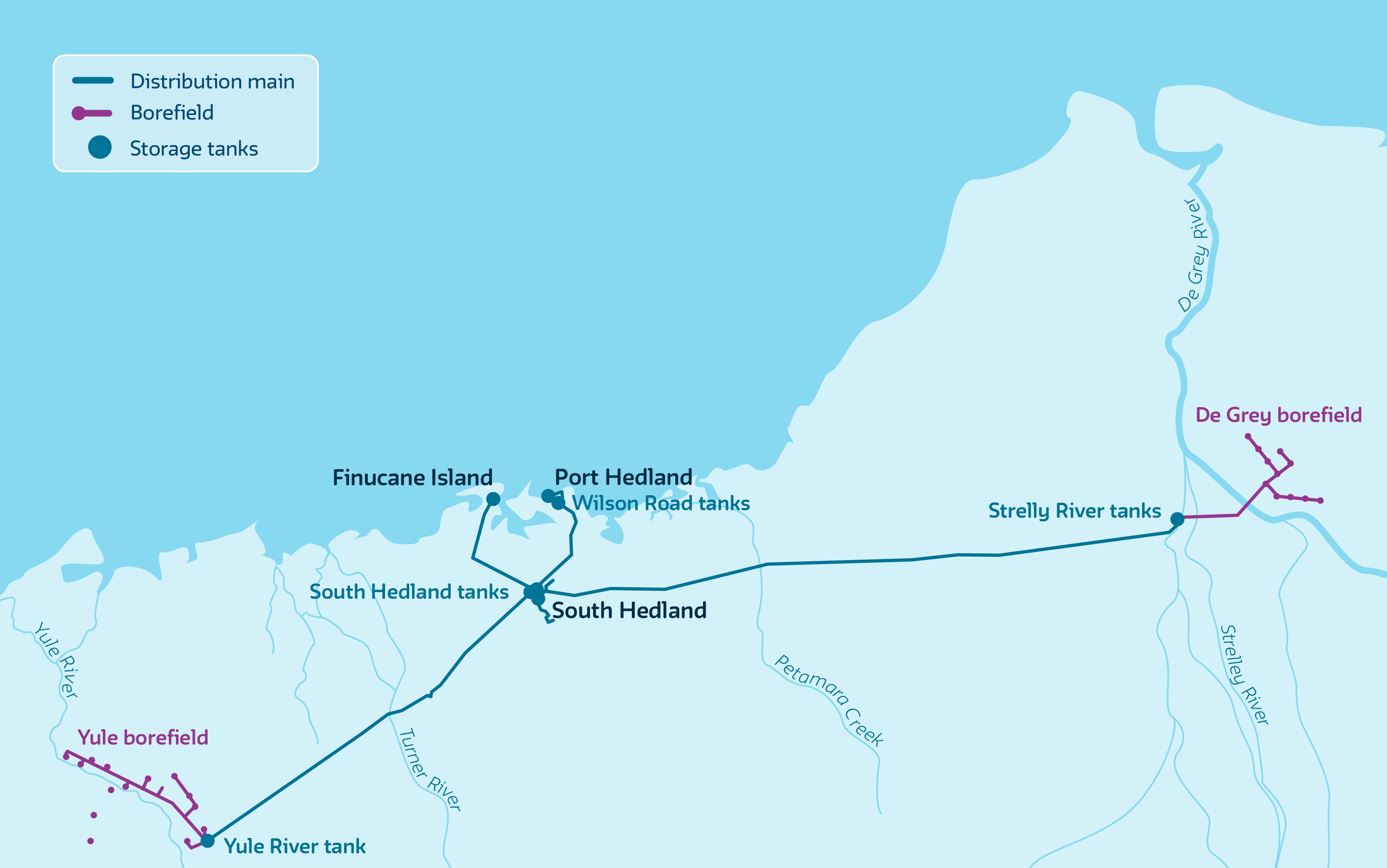
The Port Hedland scheme services customers in Port and South Hedland, Wedgefield and Finucane Island and the Aboriginal communities of Jinparinya, Marta Marta, and Punju Njamal.
The scheme currently sources water from the De Grey Borefield, located approximately 70 kilometres east of Port Hedland and the Yule Borefield, located approximately 45 kilometres southwest of Port Hedland. The Yule and De Grey Borefields draw water from superficial underground aquifers adjacent to river channels.
Why do we need a new water source?
Port Hedland is growing. More homes, businesses and industry mean more water is needed each year. At the same time, our current groundwater supply is becoming less reliable, due to greater rainfall variability and longer dry seasons across the region.
We are already using about 80% of our licensed groundwater, and future demand is expected to exceed what this source can sustainably provide. By 2050, we may need up to an additional 7.5 billion litres (7.5 gigalitres) of water each year for the Port Hedland town water scheme.
That’s why we are planning ahead now. Identifying a new water source early will help ensure we can continue to provide a safe, reliable and secure water town supply for the community for many years to come.
What options are being considered?
We are investigating several options including:
· A new borefield about 25 km southeast of the existing De Grey Borefield
· A local seawater desalination plant
· Bulk water supply options identified through a Registration of Interest process
We will continue to refine these options to ensure a reliable and sustainable water supply for the area. It is possible that more than one option will be developed over time, depending on the results of ongoing investigations.
Some options have already been assessed and are not currently being progressed, including:
· Expanding the existing Yule borefield, and
· Developing a new borefield in the West Canning Basin, where groundwater is fully allocated.
What are the next steps?
We will consult with key stakeholders to understand social, environmental, cultural, heritage and operational requirements associated with each option. As the project progresses, we will also engage with the broader community.
What other actions are being taken to support Port Hedland's water future?
We’re continuing our focus on the Waterwise Program in Port Hedland. This includes working with the Town of Port Hedland, local aquatic centres and businesses to use water more efficiently and build a more climate-resilient and liveable community. These actions help reduce overall water demand across the Port Hedland scheme.
There are also Waterwise offers available for the community, such as showerhead swaps and toilet rebates. We encourage the community to take up these offers and look for simple ways to save water at home and in the garden. To find the latest offers and how to apply, visit our Waterwise programs page.
We are also working closely with industry. Industry has a responsibility to use water wisely and avoid waste. We’re supporting high water users to find practical ways to improve efficiency and ensure water used is fit for purpose.
Another key focus is the use of recycled wastewater to water public open spaces, such as parks and sporting ovals where possible. Using recycled water helps protect valuable drinking water supplies while supporting liveable communities.
These actions help reduce pressure on the system while we deliver new sources.
What water infrastructure is planned for the Boodarie Strategic Industrial Area?
The State Government is planning long-term water supply for the Boodarie Strategic Industrial Area (SIA) to support future industry. The 2026 State Budget included funding to investigate water supply options for the Boodarie SIA and broader Port Hedland industrial growth. This work looks at both short-term (interim) and long-term solutions. Planning is being done together across government agencies, with Water Corporation providing technical and strategic advice. The work includes:
· Studying future water supply options
· Planning corridors for pipelines and infrastructure
· Aligning supply with future industry demand
Further information on the Boodarie SIA can be found on the WA government website https://developmentwa.com.au/projects/industrial-and-commercial/boodarie-sia/overview
Water Corporation is licensed to take up to 8 gigalitres (8 billion litres) per year from the De Grey Borefield and 8.5 gigalitres (8.5 billion litres) per year from the Yule Borefield. Both sources rely on heavy episodic rainfall events, such as cyclones and tropical lows, for recharge.
Current scheme demand is approximately 80% of our groundwater licence.
Before we determine the location of a preferred water source, we consider the following factors at a minimum:
- Water quality
- Drying climate patterns and rainfall/streamflow data
- Impacts on local ecosystems and flora and fauna habitats
- Aboriginal Heritage and Native Title rights
- Community feedback and impact on private landowners
- Water treatment requirements and amount of water needed
- Cost of supplying water to our customers, including building the required infrastructure
-
Several factors are considered when planning a seawater desalination plant to ensure it is efficient, reliable and environmentally responsible, including:
-
Seawater intake location - The intake must access clean, good-quality seawater. This helps reduce treatment needs, plant size and environmental impact. Intakes can be from the ocean or below the surface.
-
Plant location - Building the plant close to the water source improves efficiency and reduces costs and impacts. A site of up to eight hectares may be needed, depending on design, treatment processes and ground conditions.
-
Brine outfall location - Desalination creates salty water (brine), which is safely returned to the ocean. The outfall must allow good mixing in the water to minimise environmental impacts.
-
Power supply - Desalination uses energy. We aim to use renewable energy where possible, in line with our target to reach net zero emissions by 2035.
-
Transfer infrastructure - Pipes and pumps are needed to move treated drinking water from the plant into the existing water network.
-
While investigations into a potential new source are continuing, we are also seeking to better understand other large-scale supply opportunities through a Registration of Interest (ROI) process. A number of third parties have expressed interest in developing bulk water sources in the Pilbara. The ROI allows us to assess East Pilbara proposals including their suitability, cost, reliability and timing.
The ROI is focussed on medium-to-long term bulk drinking water supply, noting that alternative water sources may also be suitable for non-drinking uses such as irrigation or industrial process water.
Yes. We’re confident that current water supplies can continue to meet Port Hedland’s needs while planning continues for a new major water source.
We’re working closely with the Town of Port Hedland and developers to carefully plan how new projects are delivered over time. Proposals that need large amounts of water (more than 49,000 litres per day) are managed carefully. These types of projects are few and often take many years to complete.
To support these developments, we can stage land releases and use appropriately sized water meters. This helps manage demand and avoids putting too much pressure on the existing water supply system.
We’re committed to supporting Port Hedland’s growth. We’ll keep working with local government, industry and the community to make sure water is used wisely and managed sustainably now and into the future.
The Department of Water and Environmental Regulation (DWER) manages water resources across Western Australia. DWER sets how much water can be taken from groundwater and surface water sources. It also protects the environment and ensures water use is sustainable.
You can find more information about water planning in the Pilbara on the WA Government website https://www.wa.gov.au/service/natural-resources/water-resources/pilbara-groundwater-allocation-plan
Water Corporation supplies water, wastewater and drainage services to homes and businesses across the state.We are regulated by DWER and the Department of Health. The Economic Regulatory Authority sets our licence to operate and service standards
Emma Halligan - Community Engagement Specialist